
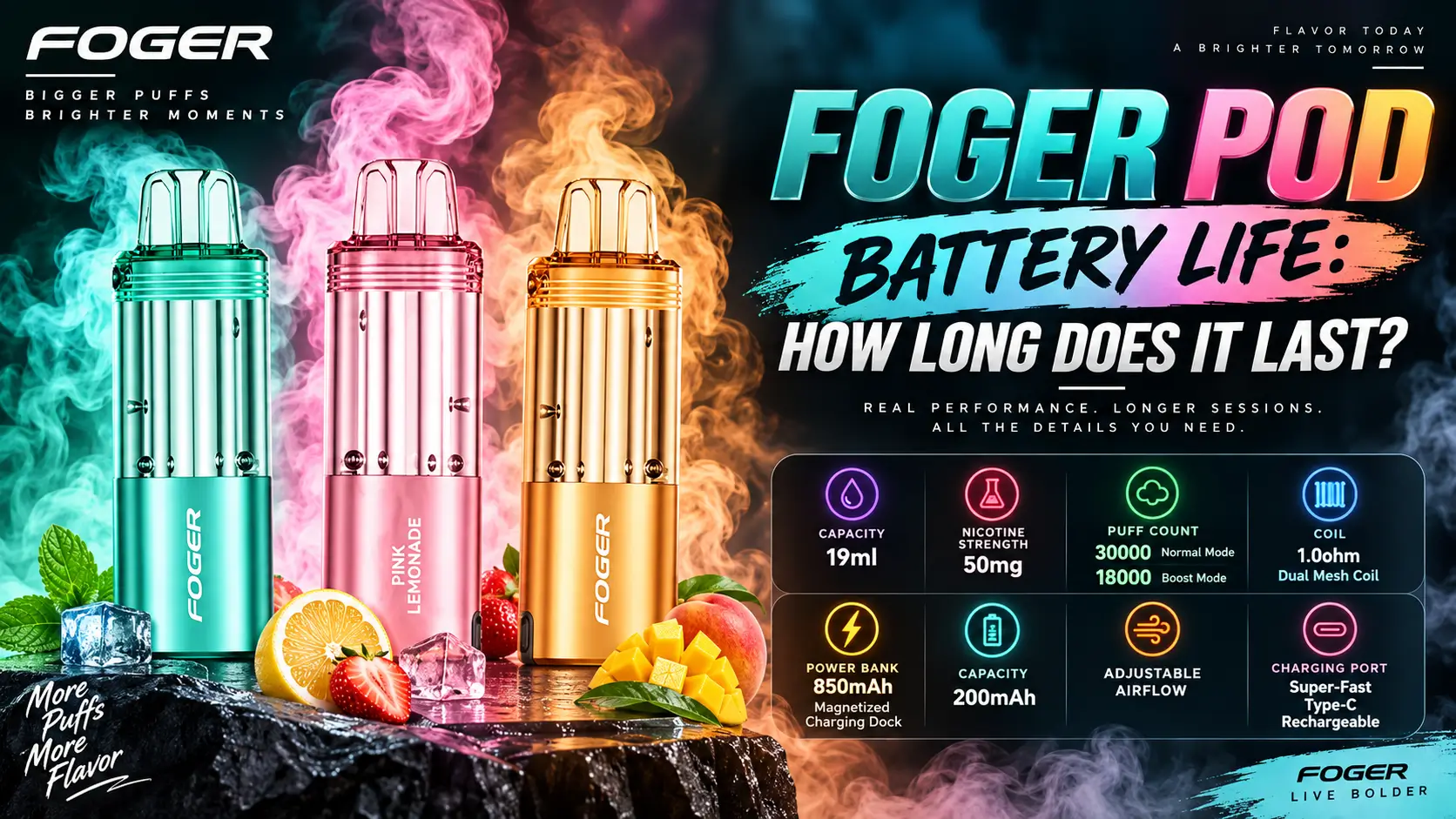
Foger Pod Battery Life: How Long Does It Last?
Real mAh specs, charge times, and how many days a full charge actually lasts on the Switch Pro 30K and Bit 35K — plus what quietly kills battery life faster than it should.
Short answer: Foger Pod battery life comes down to the Switch Pro 30K's combined 1,050mAh setup (an 850mAh dock plus a 200mAh pod), versus the Bit 35K's single 850mAh cell. In real-world terms, that's roughly 7-10 days of typical use per charge before you're back on the USB-C cable.
Battery life is the single biggest factor in how satisfying a device feels day to day, and it's also the spec buyers ask about most before they buy Foger Pods for the first time. A great flavor doesn't matter much if the device dies halfway through your afternoon.
This guide breaks down the actual battery specs for both devices, how many hours you can realistically expect, what drains a charge faster than it should, how to tell when a battery is actually dead versus just low, and a few habits that noticeably stretch runtime.
None of this is guesswork pulled from marketing copy — the mAh figures, puff ratings, and charge-time ranges below reflect the specs published across the device's official product listings and third-party hardware reviews, cross-checked against each other rather than taken from a single source.
Foger Pod Battery Specs
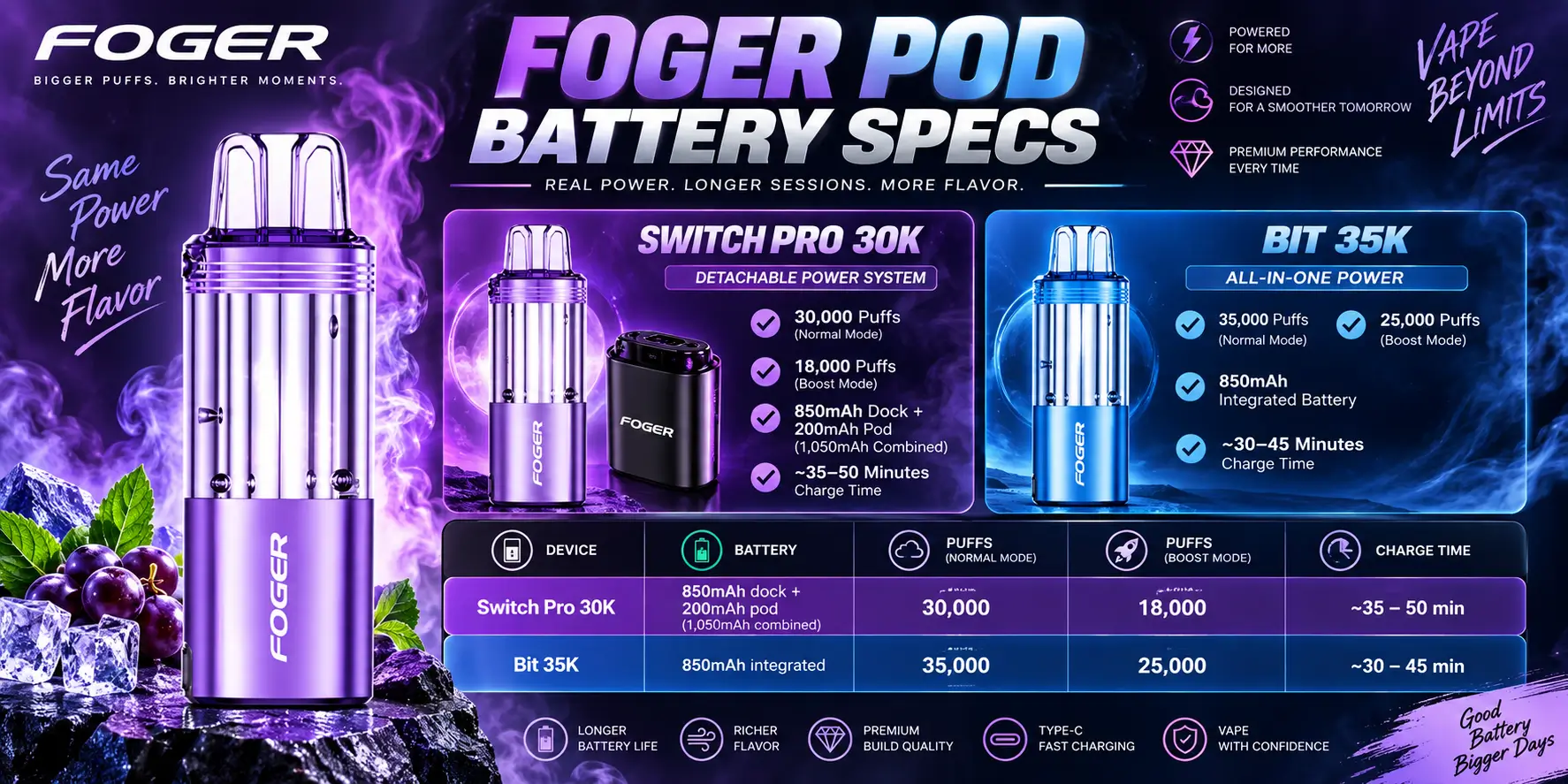
Both Foger devices use rechargeable lithium-ion batteries with USB-C charging, but the two systems are built differently. The Switch Pro splits its power across two components, while the Bit 35K keeps everything in one sealed unit.
The Switch Pro 30K Kit pairs an 850mAh magnetic charging dock with a 200mAh cell built into each disposable pod, for 1,050mAh combined when the two are connected. The dock is the part you actually plug in; the pod's small internal cell exists mainly so it can still fire on its own for short stretches if the dock ever runs flat.
The Bit 35K takes the simpler route with one integrated 850mAh battery and no separate parts to manage. That single-cell design is part of why so many people researching what Foger Pods actually are tend to land on the Bit 35K first — it's the more straightforward of the two systems for a new vaper.
Puff ratings are always measured in Normal Mode under standard lab draw conditions, so your real count will shift depending on draw length and how often you switch into Boost. If you want the full breakdown of what that number actually means in practice, the how many puffs in a Foger Pod guide covers it in more detail.
Why Two Different Battery Designs?
The split-battery Switch Pro exists so you never have to throw away a working battery just because one pod ran dry. You keep the dock, swap the pod, and the dock's 850mAh cell keeps doing the heavy lifting across dozens of flavor changes.
The Bit 35K skips that complexity entirely. It's a single sealed device, which trades long-term cost savings for genuine grab-and-go simplicity — no docking, no swapping, just charge and vape.
Does Flavor Choice Affect Battery Drain?
No — flavor itself has essentially no measurable effect on how fast the battery drains. E-liquid viscosity varies slightly between profiles, but the coil and wattage settings are what determine power draw, not which flavor is loaded into the pod.
That's good news if you like rotating through options, since working your way through the Best Foger Pod Flavors lineup won't cost you any extra battery life compared to sticking with one flavor the whole time you own the device.
How Many Hours Does It Last?
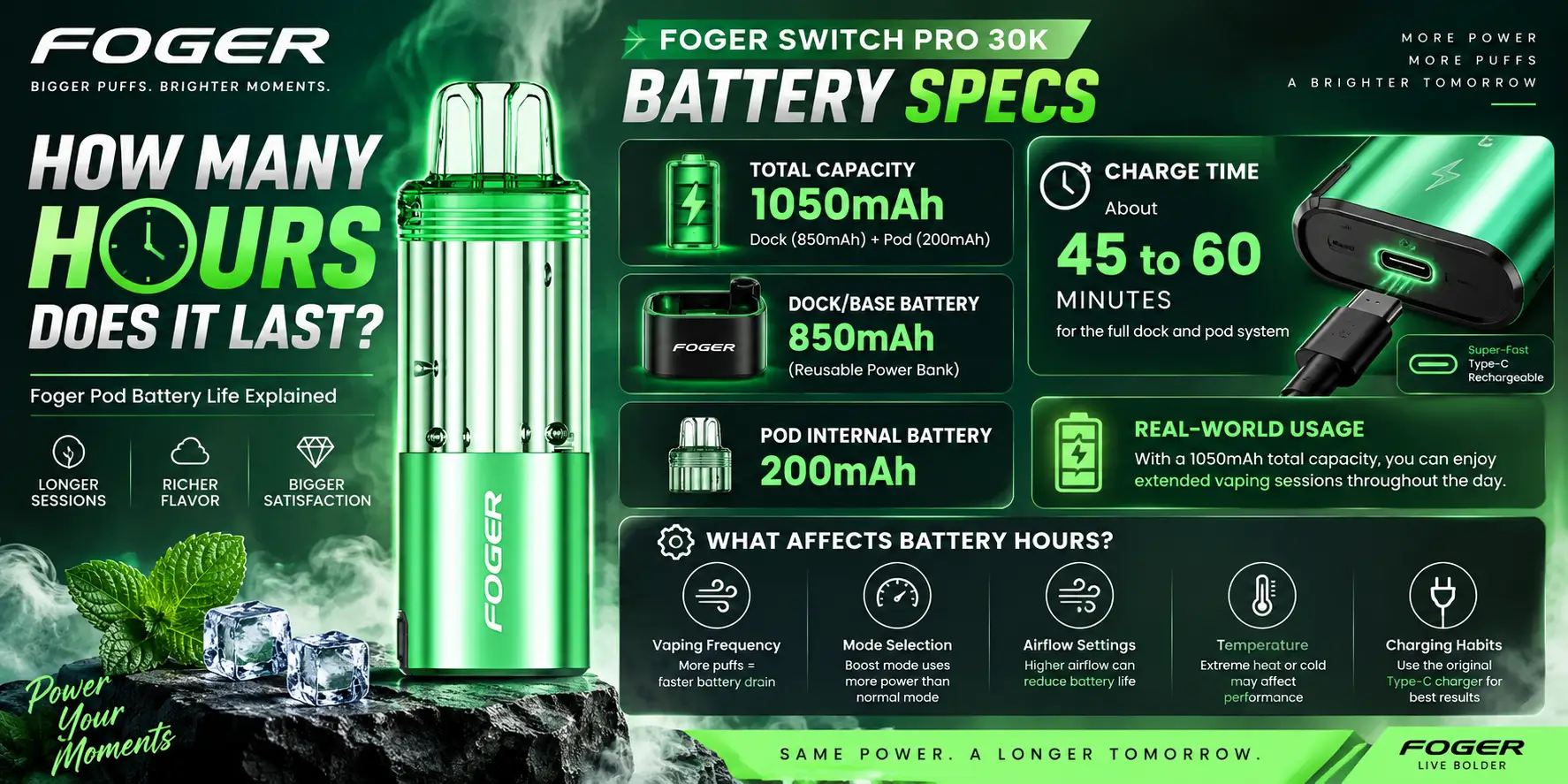
For a moderate user pulling 150-250 puffs a day, a fully charged Bit 35K typically lasts 7-10 days before needing a recharge, and a Switch Pro dock lasts roughly the same window across however many pods you swap through.
Neither device is rated in "hours" the way a phone battery is, because vaping is intermittent rather than continuous draw. What actually matters is puffs per charge, and both devices land in a similar practical range once you do the math.
Working backward from the puff ratings: a full Bit 35K charge supports somewhere around 1,200-1,800 puffs in Normal Mode before it needs a top-up, and a fully charged Switch Pro dock supports a comparable 1,500-2,000 puffs per charge cycle. Heavy users burn through that in 2-4 days; light users can stretch a single charge over a week or more.
Boost Mode changes this math meaningfully. Because it pushes more wattage per draw, a charge that would normally last a week in Normal Mode might only get you 4-5 days if you're running Boost most of the time.
A Rough Daily Breakdown
- Light user (under 100 puffs/day): a single charge can last 10-12+ days
- Moderate user (150-250 puffs/day): expect 7-10 days per charge
- Heavy user (400+ puffs/day, frequent Boost use): 3-5 days per charge is typical
Does Battery Life Change the Real Cost Per Puff?
Yes, indirectly. A device that reliably hits its rated puff count per charge is getting closer to its actual cost-per-puff value, while one that dies early — usually from heavy Boost use or a defective cell — effectively costs more per puff than advertised.
Since Switch Pro pods and Bit 35K units are priced per device rather than per charge cycle, getting the full rated puff count out of each charge is what makes the math in a how much are Foger Pods breakdown actually hold up in daily use. A pod that underperforms its battery rating is the most common reason people feel like they're going through devices faster than expected.
Factors That Affect Battery Life
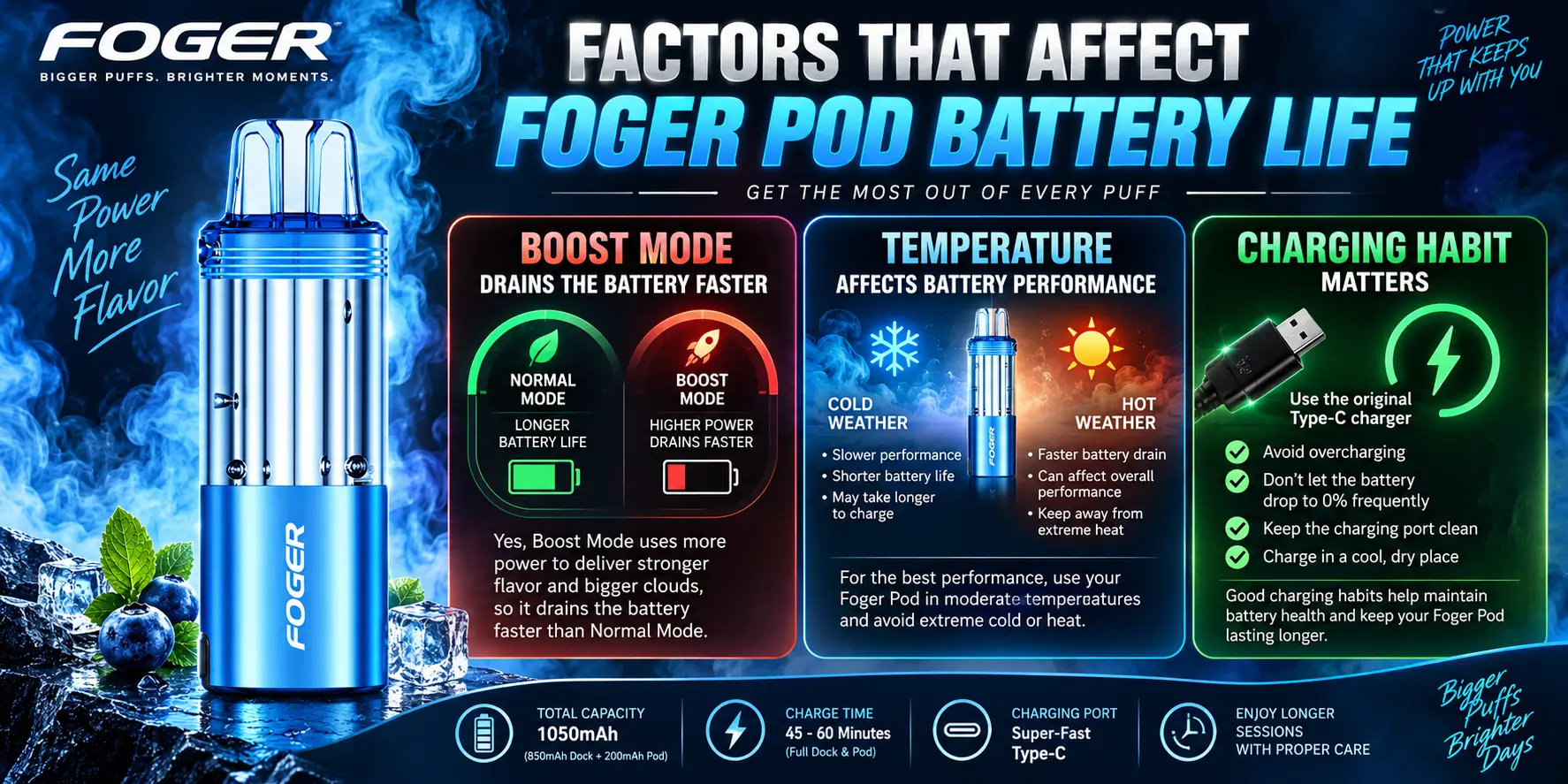
Battery life isn't fixed — it swings based on how you use the device, how you store it, and even the weather. The three biggest variables are power mode, temperature, and charging habits.
Does Boost Mode Drain the Battery Faster?
Yes, noticeably. Boost Mode increases wattage output to produce thicker clouds and a stronger throat hit, and that extra power draw is exactly why the puff rating drops from 30,000/35,000 down to 18,000/25,000 on Boost.
If your device seems to die faster than the rated puff count suggests it should, Boost usage is the most common explanation. Switching back to Normal Mode for most of your day and saving Boost for occasional use stretches a charge considerably.
Does Temperature Affect a Foger Pod's Battery?
Yes — lithium-ion cells lose efficiency in both extreme heat and extreme cold, which is standard behavior for this battery chemistry across every consumer electronics category, not just vapes. Leaving a device in a hot car or an icy pocket during winter measurably shortens runtime for that session.
Room-temperature storage keeps the battery performing closest to its rated spec. A device that's been sitting in direct sunlight or a freezing car will often show a lower battery percentage than it actually has once it returns to normal temperature.
Does Charging Habit Matter?
It does, over the long run. Repeatedly running a battery down to 0% before recharging, or leaving it plugged in well past a full charge, both put extra stress on a lithium-ion cell over hundreds of cycles.
Topping up before it hits empty and unplugging once it reaches 100% is the simplest way to protect long-term capacity, whether you're new to the brand or you already know how to use Foger Pods inside and out.
This is standard lithium-ion behavior, not a Foger-specific quirk. The same charge-cycle math applies to phones, laptops, and any other rechargeable lithium device — deep discharge cycles and prolonged overcharging both accelerate long-term capacity loss across the entire battery category, not just vapes.
Does the OLED Screen Drain the Battery?
Slightly, but not enough to worry about. The OLED display draws a small amount of power each time it activates to show puff count or battery level, but it's designed to sleep automatically between draws rather than staying lit continuously.
Compared to the power draw from actually heating the coil, the screen's contribution to overall battery drain is minor. You won't meaningfully extend battery life by trying to avoid checking the display — the coil, not the screen, is what does the real work.
How to Know When Battery Is Dead
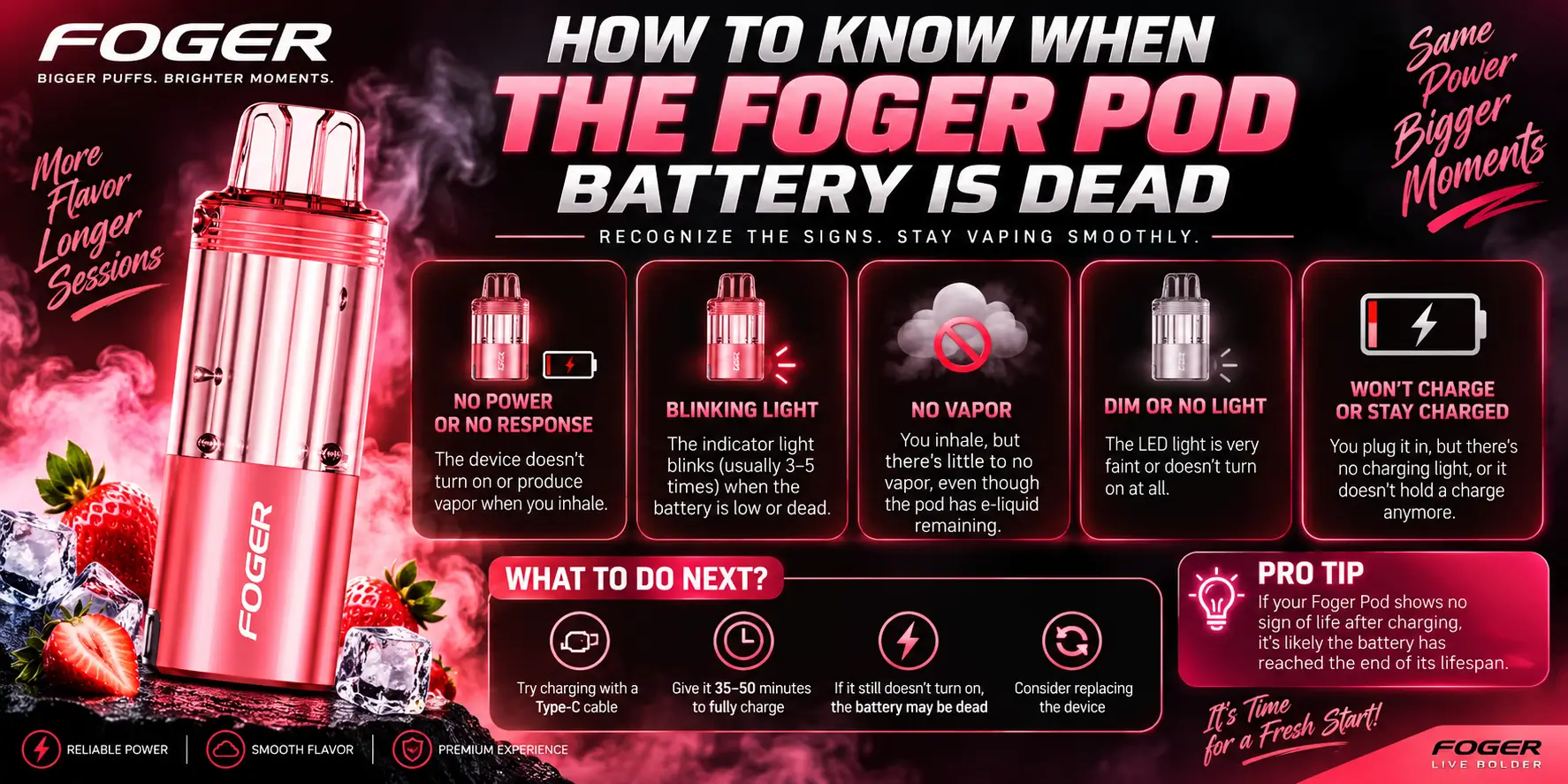
The clearest sign is the OLED display itself — both devices show a live battery indicator, and most users notice draws getting noticeably weaker in the last 10-15% before it cuts out completely.
A dying battery on either device typically shows up as a blinking screen icon, a sudden drop in vapor production, or the device failing to fire on a normal draw pull. That's your cue to plug in rather than keep trying to squeeze out a few more puffs.
There's a difference worth knowing between the pod running out of e-liquid and the battery actually dying — an empty pod on the Switch Pro will still show battery life on the dock, while a genuinely dead battery won't power the display at all, even with e-liquid remaining.
Signs to Watch For
- Weak, noticeably cooler draws compared to earlier in the day
- A blinking or dimmed battery icon on the OLED screen
- The device fails to activate on a full draw despite liquid remaining
- No display response at all when picked up (fully dead, not just low)
If you're seeing any of these consistently sooner than the rated puff count would suggest, it's worth comparing notes against a full Foger Pod review to rule out a defective unit rather than normal wear.
Can You Recharge a Foger Pod?
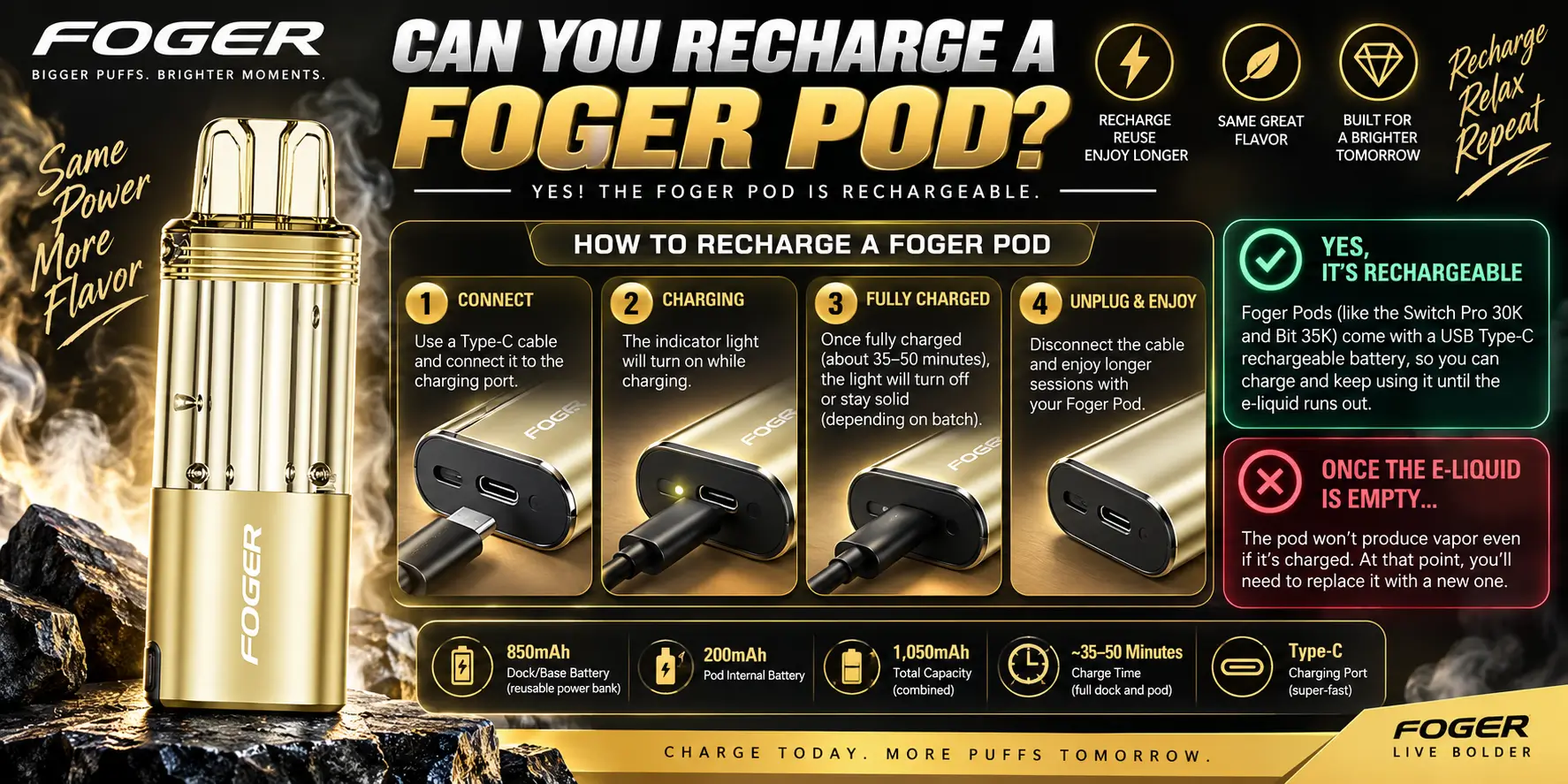
Yes, both the Switch Pro dock and the Bit 35K recharge via USB-C, typically reaching a full charge in 30-50 minutes depending on the device and your power source. Neither uses a proprietary charger — any standard USB-C cable works.
The Switch Pro's disposable pod itself is not separately rechargeable in the traditional sense; its small 200mAh cell gets topped up automatically through the magnetic connection whenever the dock is charging, so you only ever plug in the dock directly.
The Bit 35K is fully self-contained, so "recharging the pod" and "recharging the device" mean the same thing — there's only one battery to manage.
That single-battery simplicity is one reason the Bit 35K gets recommended so often to vapers switching over from other disposable brands — there's no dock to keep track of and no separate charging schedule to remember, just one cable and one device.
Does a Fast Charger Charge It Quicker?
Not really, and it can actually cause problems. Both devices are built around a standard 5V/1A charging profile, and higher-voltage fast chargers from phones or laptops can trigger the built-in overcharge protection, sometimes halting the charge entirely rather than speeding it up.
Sticking with a standard USB-C cable and a basic wall adapter or laptop port is the safest, most reliable way to get a full charge without tripping that safety cutoff.
If your local shop is out of a working charging cable, most standard USB-C cables from other electronics work fine — you don't need a Foger-branded one specifically, and checking a nearby Foger Pods near me listing can help if you need a replacement cable same-day.
Tips to Extend Battery Life
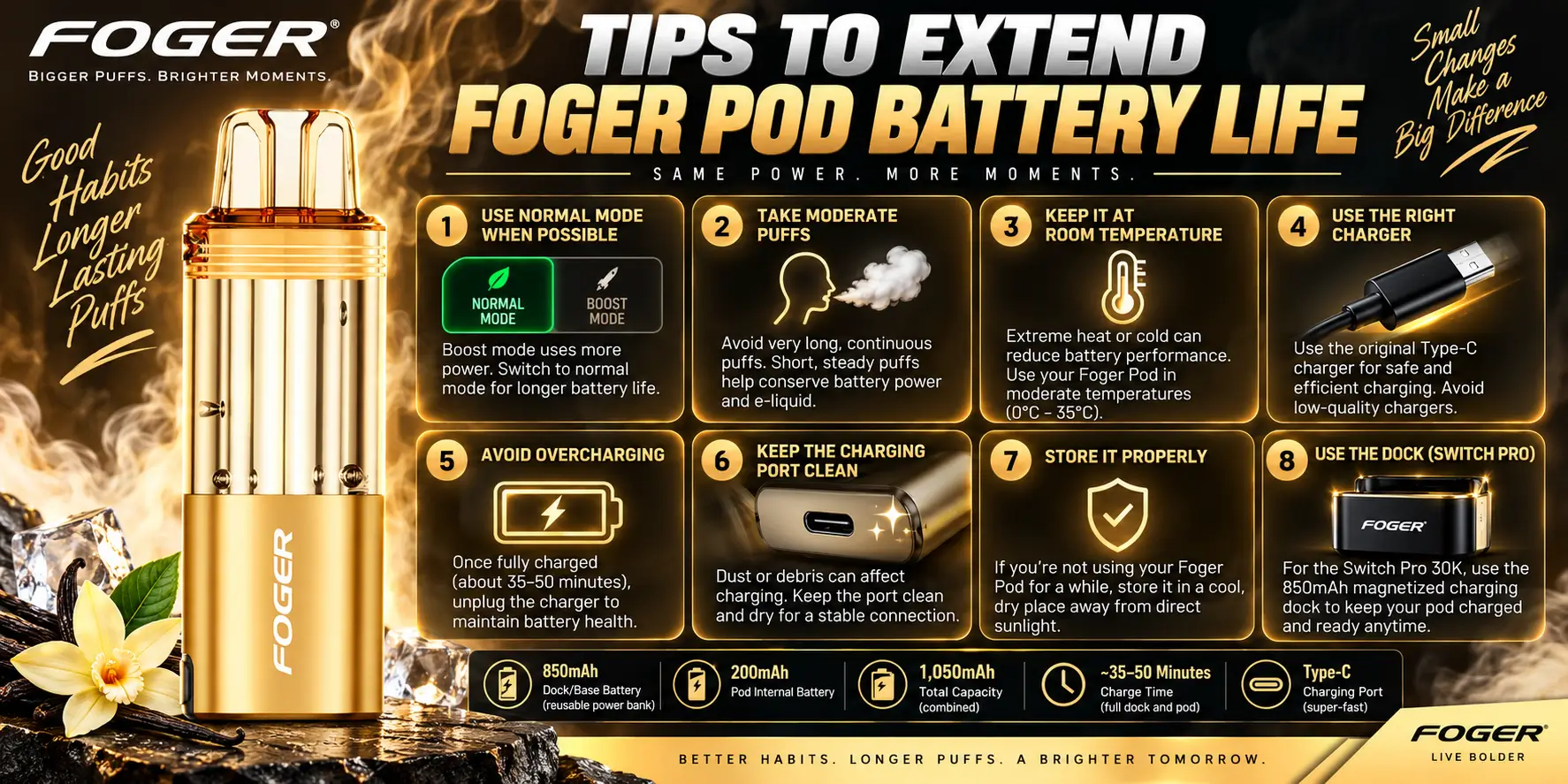
A few small habits add real days of extra use across a battery's lifespan, and none of them require buying anything extra.
- Charge before it hits zero. Topping up around 15-20% remaining is gentler on the cell than repeatedly draining to empty.
- Unplug once it's full. Leaving a device plugged in overnight after it's already charged adds unnecessary stress over time.
- Favor Normal Mode. Save Boost for when you actually want the extra cloud and throat hit, not as your default setting.
- Store at room temperature. Avoid leaving the device in a hot car, direct sun, or a freezing coat pocket for extended periods.
- Use the included or a compatible standard cable. Skip aggressive fast chargers that can trigger the overcharge cutoff.
- Keep the charging port clean. Lint buildup in the USB-C port is a common, overlooked cause of slow or failed charging.
Following these habits won't change the rated puff count, but it does keep the battery performing closer to that rating for longer, and it reduces the odds of a battery degrading faster than expected — a common complaint in less favorable reviews of the category compared to how devices like Foger Pods stack up against Elf Bar on longevity.
None of these habits require special tools or extra spending. They're the same basic battery-care principles that apply to most rechargeable electronics, just applied consistently over the life of the device rather than followed once and forgotten.
Ready for a Fresh Charge and a Full Flavor Lineup?
All flavors, current pricing, verified authentic.
Shop Foger Pods →Prefer another checkout option? Genuine Foger Vapes are also stocked at verified retail partners.
FAQs
1. How long does a Foger Pod battery last on a single charge?
A Bit 35K typically lasts 7-10 days for a moderate user, and a Switch Pro dock lasts a similar window across however many pods you swap through during that time.
2. How long does it take to fully charge a Foger Pod?
Roughly 30-50 minutes via USB-C, depending on the device and your power source. A standard 5V/1A charger gives the most reliable result.
3. Does Boost Mode reduce battery life?
Yes. Boost Mode increases wattage for stronger clouds and throat hit, which is why the puff rating drops from 30,000/35,000 in Normal Mode down to 18,000/25,000 on Boost.
4. Can I use a fast charger to charge my Foger Pod quicker?
It's not recommended. High-voltage fast chargers can trigger the device's built-in overcharge protection and stop the charge rather than speed it up. Stick with a standard USB-C cable.
5. How do I know if my Foger Pod's battery is actually dead versus just low?
A low battery still lights up the OLED display and shows a battery icon, even if draws feel weaker. A fully dead battery won't power the display at all, even if the pod still has e-liquid left.
Battery life ultimately comes down to a mix of the device's rated spec, how much Boost Mode you use, and a handful of simple charging habits. Get those three things right and both the Switch Pro and the Bit 35K will consistently land close to their advertised puff counts, charge after charge.